BER certificates in Ireland: find, get and understand yours
Your Building Energy Rating matters for selling, renting, mortgages and most home energy grants. Here is how to find it, get a new one and read it.
BER scale
A0ABCDEFG
Quick answer: A BER rates your home’s energy performance from A0 (best) to G. Find a home’s certificate on SEAI’s National BER Register using its 11-digit MPRN or 9-digit BER number. For the advisory report, a BER published before 6 July 2021 requires the MPRN; either identifier works from that date. A new BER is done by an independent SEAI-registered assessor. Better Energy Homes offers a standard €50 BER grant or a higher €280 rate for homeowners on qualifying welfare payments: check the eligibility and previous-application conditions.
✓ Independent guidance✓ Checked against official sources✓ Explore without signing up
Key facts
BER scale
A0, A, B, C, D, E, F and G
Valid for
Up to 10 years, unless changes affect energy performance. Provisional new-build BERs last 2 years
Required when
Selling or renting, subject to exemptions explained by SEAI
Find an existing BER
Use the MPRN or BER number for the certificate; older advisory reports need the MPRN
Who does a BER
An independent BER assessor registered with SEAI, hired directly by the owner
Cost
Set by each assessor. SEAI recommends getting at least three quotes
Grants
Better Energy Homes: standard €50 or higher €280 for homeowners on qualifying welfare payments. Conditions apply
The new BER scale (from 24 May 2026)
The simplified BER scale
Rating
What it means
A0
Most efficient; no fossil fuels
A and B
Very efficient: usually well insulated, with modern heating
C and D
Room to improve
E, F and G
Least efficient: typically poorer insulation and older heating
Source: SEAI’s simplified BER scale, introduced 24 May 2026.
Eight levels replaced 15. The scale change does not restart a certificate’s validity period: check its expiry date and whether later changes to the home affect its validity. New certificates also show energy use, renewable contribution, lifetime carbon (Global Warming Potential) and a QR code for upgrades.
For the standard One Stop Shop route, the old B2 target after the work became B. SEAI says the minimum improvement needed has not changed.
How to find your existing BER and advisory report
Find an identifier: your MPRN has 11 digits and is on your electricity bill; the BER number has 9 digits and is on the certificate.
Get the dwelling’s advisory report: if the BER was published before 6 July 2021, search using the MPRN. For BERs published on or after that date, either identifier works.
Buying or renting and missing the MPRN? Ask the owner or agent for the advisory report.
Can’t find a record? Check the identifier first. An expired BER needs a new assessment; a missing BER may have been revoked, in which case contact the assessor. See SEAI’s lookup help. If the home has never had a BER, the next section explains how to get one.
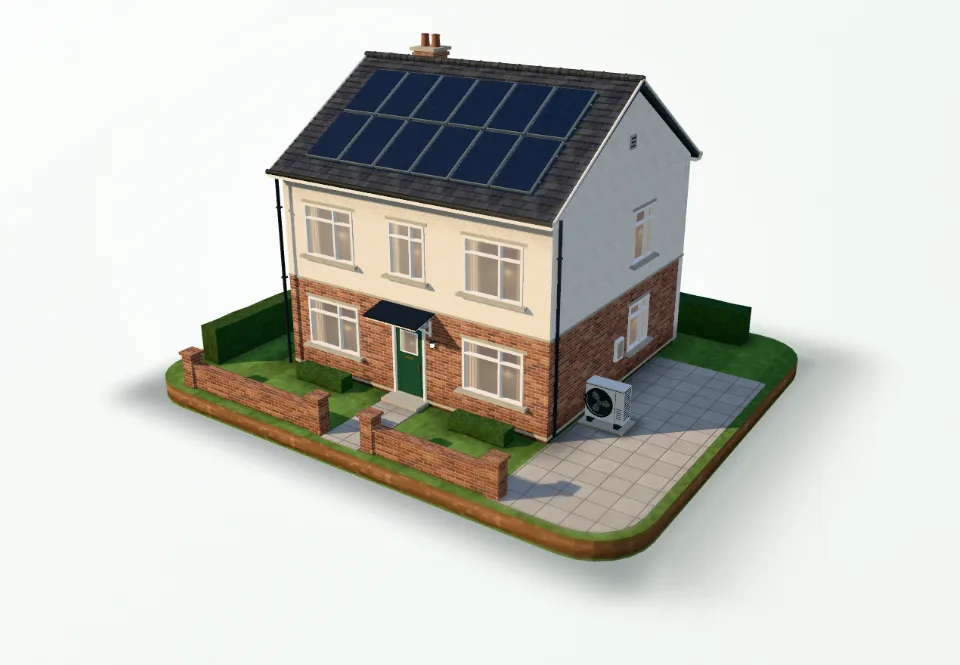
You don’t need a BER to explore the upgrades on our 3D home. Before arranging grant-funded work, check the relevant scheme’s BER and approval requirements.
No BER yet? You can still explore the upgrades, grants and typical costs in 3D.
Find an assessor: use SEAI’s public BER assessor search and choose a domestic dwelling assessor. Assessors must be independent and hired directly by you, not supplied as part of a contractor’s package.
Get quotes: SEAI recommends contacting at least three assessors. The quote should include VAT and expenses and any business interests.
Prepare your paperwork: your MPRN and Eircode, proof of the year the home was built, and receipts or certificates for any upgrades. Without evidence, the assessor must use cautious default values, which can give a lower rating.
Give clear access: the assessor needs to see the attic, heating system and controls, hot press, windows, doors and meters.
Finish any upgrades first: works should be done before the survey so the BER reflects them.
BERs and home energy grants
Most SEAI individual grants need a post-works BER before the grant is paid. A later upgrade may still require one without another BER contribution.
The Better Energy Homes application form limits the standard €50 BER grant to once per home. It is added automatically when other qualifying measures are funded and the homeowner has never previously applied for a BER grant.
If you or a previous owner applied for a BER grant before, ask SEAI how the home’s grant history affects your application, including eligibility for the higher rate. Do not assume another BER grant or a top-up is payable.
Your BER also decides some grant rules:
The heat pump grant uses the Heat Loss Indicator (HLI) in your BER. Homes built before 2007 with an HLI of 2.3 or lower can skip the technical assessment.
The windows and doors grant needs attic and walls rated Good or Very Good, or an HLI of 2.3 or lower after the work.
Select an upgrade on our 3D home to compare grant options, conditions and typical costs. When you are ready, choose the work you want and request a quote from one registered contractor who covers your county. The figures are guidance; your contractor checks the work and SEAI decides grant eligibility.
Search SEAI’s National BER Register using the 11-digit MPRN from your electricity bill or the 9-digit BER number from the certificate. For a dwelling’s advisory report, use the MPRN if the BER was published before 6 July 2021; either identifier works on or after that date.
Up to 10 years, unless changes affect the home’s energy performance. Provisional new-build BERs last 2 years. The May 2026 scale change does not renew an older certificate. Check the expiry date and SEAI’s validity guidance.
Each assessor sets their own price, depending on the size and type of home. SEAI recommends asking at least three assessors for a quote that includes VAT and expenses. Better Energy Homes has a standard €50 BER grant and a higher €280 rate for homeowners on qualifying welfare payments; check the grant conditions and previous-application limits.
A report that comes with your BER. It suggests upgrades and rates parts of the home, such as the attic and walls. Use it to discuss options with a professional; it is not a contractor’s quote or a grant approval.
Yes. This guide shows how to find your MPRN and your report and what the key figures mean for grants. You can also explore the main upgrades, grant options and typical costs on our 3D home without uploading or finding a BER report first. The explorer is guidance; a registered assessor provides a BER.
The full source review for this guide is dated . BER lookup, advisory-report access, certificate validity, assessor-search guidance and standard/enhanced Better Energy Homes BER support were checked on . The Traditional Homes Pilot route and its BER exception were checked on . Other scheme-specific BER thresholds retain their earlier review date.